

By now, most of us have experienced all the benefits and great things that come with remote work. From flexibility to better work-life balance, the list goes on and on. However, despite its great advantages and opportunities, remote work has also had a significant impact on remote workers.
Whether it’s the lack of social interaction or the longer hours working at home, remote work burnout statistics show how important it is to cultivate a healthy workplace regardless of its location.
Burnout is still a major issue company leaders need to tackle. Let’s go over some of the main remote work burnout statistics to take into consideration for 2024.
of us have experienced all the benefits and great things that come with remote work. From flexibility to better work-life balance, the list goes on and on. However, despite its great advantages and opportunities, remote work has also had a significant impact on remote workers.
Whether it’s the lack of social interaction or the longer hours working at home, remote work burnout statistics show how important it is to cultivate a healthy workplace regardless of its location.
Burnout is still a major issue company leaders need to tackle. Let’s go over some of the main remote work burnout statistics to take into consideration for 2024.


General Remote Work Burnout Statistics: 2023 Overview

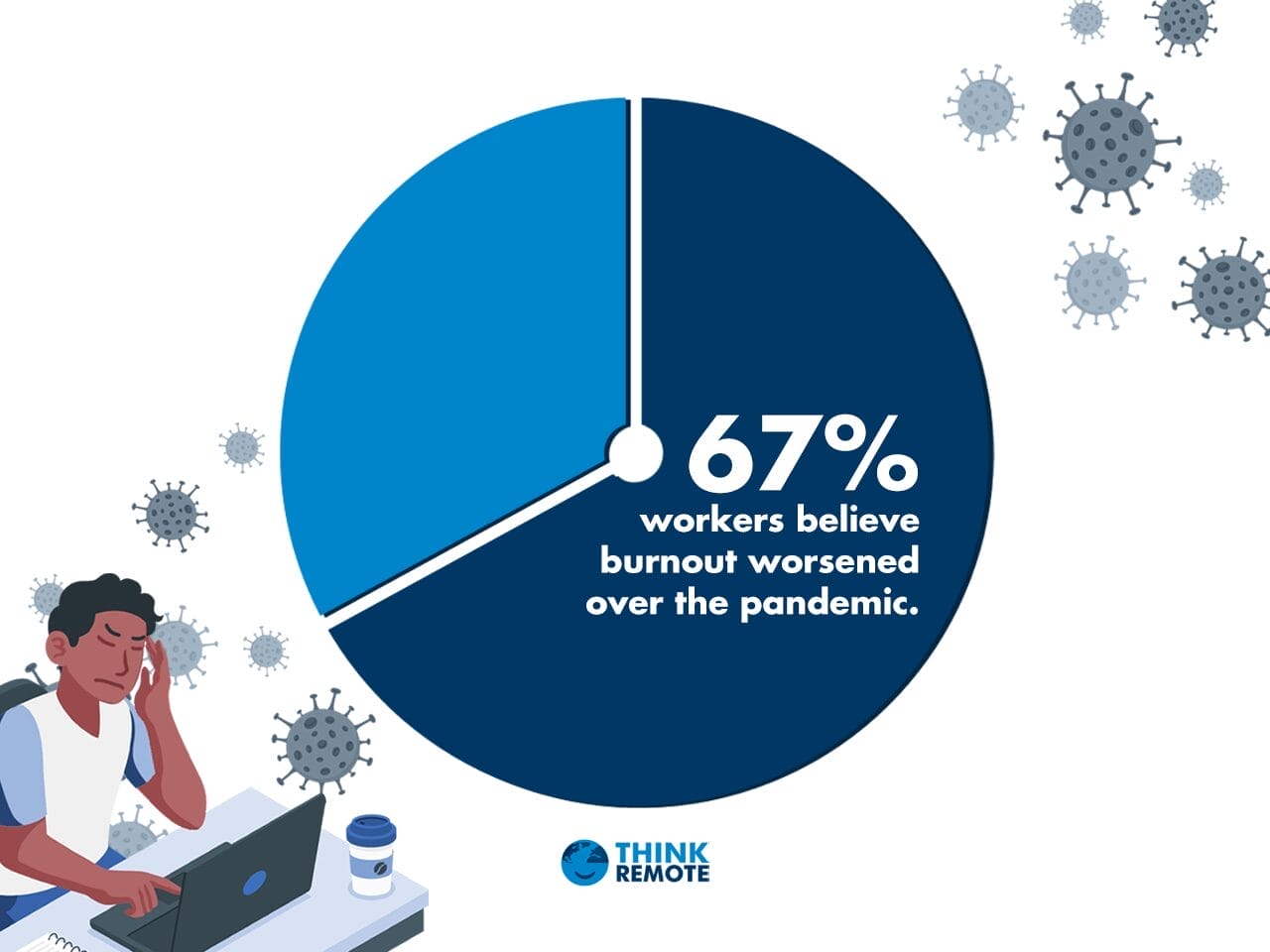
- 67% of workers surveyed believed burnout worsened over the course of the pandemic.
- Remote work has affected 76% of surveyed workers’ mental health negatively, with loneliness increasing by 67% for those who work remotely full-time.
- 53% of virtual or work-from-home employees are working more hours than they did in the office. Nearly one-third (31%) say they are working “much more” than before the pandemic.

- Among remote workers, 86% report experiencing burnout in their current positions, compared to 70% of in-person workers.
- Over half of remote workers state they are working more hours virtually or at home than they did in the office.
What Factors Contribute to Remote Work Burnout?
While leaders may argue that remote work improves work-life balance, it’s not the case for everybody. Here are some relevant remote work burnout statistics that help understand what stressors contribute to burnout:

- Difficulty in unplugging from work – During the pandemic, 61% of remote workers found it challenging to “unplug” during non-work hours, a marked increase from 22% who struggled with this before the pandemic.
- Working more hours – Similarly, the difficulty of unplugging makes it challenging to lead a healthier work-life balance. Over half of remote employees report working more hours than they did in the office, with 31% working “much more” than before the pandemic.
- Increased workload and pressure – Many remote workers have experienced an increase in their workload, making it difficult for them to finish tasks on time. One of the biggest challenges, according to a FlexJobs study, is not getting out often enough (28%).
- Lack of social interaction and isolation – The absence of casual, in-person interactions with colleagues can lead to feelings of loneliness and disconnection, which contribute to burnout. A Buffer report highlighted that remote workers’ number one struggle is staying home often and not having a reason to leave (21%), followed by loneliness (15%)

- Inadequate employer support – 51% of remote workers believe their employer does not provide adequate support to handle burnout issues. Additionally, 1 in 2 workers (49%) feel managers trust more employees who work in the office than those who work remotely.
The Impact of Burnout on Work and Personal Life
The effects of burnout extend beyond the workday, impacting both professional and personal life. Here are some of the workplace burnout statistics:
- Increased Sick Leave and Job Searching – Employees suffering from burnout are not only more likely to take sick leave but are also more actively seeking new job opportunities. Burned-out employees are 63% more likely to take a sick day and 2.6 times as likely to be actively seeking a different job.

- Effect on Personal Relationships – A significant 83% of employees report that burnout negatively affects their personal relationships, highlighting the impact of work stress on life outside of work.
- Less motivation – Nearly half (45%) of remote workers have lowered their expectations from their employers without expressing concerns about the stability and future of their positions.

- More stress – According to an Owl Labs report, almost half of remote workers (45%) say their level of stress due to work has increased somewhat or substantially during the past year.
Remote Work Burnout Statistics: Demographics
- Women are more burned out than men – Women (42%) are more likely than men to suffer from burnout (35%).
- Working mothers feel more pressure – At its height, 9.8 million working mothers suffered burnout because they had to care for their children and maintain high productivity at work.

- Working mothers experience more stress post-pandemic – While the children have returned to school or daycare, working mothers are still more prone to burnout, with a recent survey showing 53% of women are experiencing more stress now than during the pandemic.
- Millennials are the most burned-out – Compared to other generations, Millennials, particularly managers, feel more burned out (42%) than Gen Z (34%), Gen X (27%), and Baby Boomers (21%).
Remote Work Burnout: Factors That Contribute to Workplace Stress
Does the workplace environment impact the levels of stress? Definitely. While the advantage of working remotely is that you can set your own environment to what makes you feel comfortable, it can also lead to stress and eventually burnout.
- Remote workers miss the experience of the office – 52% of remote workers stated they missed changing scenery every day, and 61% said they missed having face-to-face interactions with their colleagues.

- Remote work makes work-life balance challenging – 41% of remote workers miss the distinct separation between professional and personal life typically offered by office-based work. 51% think that the office provides a clear separation between work and personal time.
- Working from home can be more distracting – 64% of remote workers believe that working from home is more distracting than working from the office.
What’s Next?
Remote work burnout statistics underscore the complexities of workplace flexibility. While this arrangement presents challenges, a significant majority of the workforce still favors remote work. Over 95% of employees express a preference for some form of remote work, whether hybrid or fully remote.
But, employers might not feel the same way. Rather than full-time remote arrangements, global trends reveal the preference for hybrid work arrangements. Currently, most employees are going to the office around 2-3 per week, aligning with leadership preference. This pattern stabilized more in the last part of 2023, suggesting a state of “hybrid work equilibrium.”
FAQ
According to the World Health Organization, burnout is a syndrome resulting from chronic workplace stress. It is characterized by feelings of exhaustion, low energy, and pessimism towards work.
In a remote team member, burnout might look like missed meetings or deadlines, being unusually quiet on calls or social channels, increased sick time, or uncharacteristic behavior like taking things personally or being snappy with colleagues.
There are things that an employer or manager can do to prevent burnout: 1) Measuring on output rather than presenteeism; if the work gets done, it doesn’t really matter whether a person was at their desk between 9 and 5, 2) Fostering a sense of belonging through virtual team-building exercises, 3) Regular one-to-one check-ins, representing your team at head office and making sure they don’t get overlooked, 4) Checking when staff last had a day off – we all need a break at time, and 5) Signing up to an employee wellbeing program that offers talking therapies or other health benefits.
No, although this depends on the personality and responsibilities of each individual.
Not necessarily. If it does, then it suggests that person may be better off working in the office. There is no hard and fast rule, but generally speaking, working from home, when the employer gets it right, improves mental well-being.
No. Working remotely improves productivity, and this has been proven in numerous research studies.